When we first got off the ferry back in early February, we had the choice to turn left or right. As it turned out, we turned left and headed in a clockwise(ish) direction around the island. This meant that the far west and north coasts would be last on our itinerary. Apart from needing some work done on the car in Launceston, we made that choice thinking that we’d enjoy the best of the summer weather on the wonderful beaches of the east coast. And we certainly did. The Bay of Fires and in particular, Swimcart Beach is still one of the highlights of our trip.
But it also meant that by the time we approached the north-west and north coasts, it would be autumn and the chance of good weather would be diminishing. This was played out in Strahan when we went on the Gordon River cruise and in our visit to Cradle Mountain, but it came home to hit us in our final two weeks.
We left Waratah in the rain and headed up through Hellyers Gorge, another narrow, winding road through beautiful rainforest, to arrive at the north coast town of Wynyard. We were sort of in the middle of the north coast, with lots to see and do further west, so we grabbed supplies at the local Woolies supermarket (only the larger small towns and cities have big-chain supermarkets - the majority of places on our travels have only had small IGA’s, if anything at all) and moved further west.
Our original plan was to stay at a free camp on the outskirts of a little service town called Smithton, but when we arrived, we were thinking it might not be the place for us. Tall Timbers was a lovely green field next to a hotel, but it was right on the main road, with trucks slowing down with their engine brakes all night. Perhaps not.
We had a Plan B though, and decided to check it out. About 20km further out on the coast, almost as far as you can go is a little fishing campground called Montagu. It’s right on the coast, but sheltered by Robbins Island and when we arrived, we were met by a lovely old man named Busta. Busta and his wife Bev are set up in their van as caretakers at the campground for 6 months - have been doing it for years. It’s mainly locals that use the place, setting up their tents/vans/whatever and leaving them set up for the 6 months that the ground is open. Then they just visit when they feel like it.
 |
| Morning at Montagu |
Busta found us a great spot, where we got sun through the day but were sheltered from the winds. The first couple of days there were beautiful, and we lazed about, walked the beaches and even got the rod out and tried a bit of fishing. Unsuccessfully, but anyway. We were invited to “happy hour” on the Saturday afternoon. A group of about 20 or so of the campers gathered together for a chinwag. Mostly older people and with lots of stories to tell. We were of interest because a) we weren’t local and b) we were a bit younger. I sat next to a lovely old lady named Judith who had been coming to Montagu since she was a girl and she was full of great info about places to go, but by far the most interesting discussion we had was about the mutton bird harvest that was about to begin.
The islands off the north-west coast are breeding grounds for mutton birds (or short-tailed shearwaters) and each year there’s a hunting season. It sounded a bit brutal, but people have been doing it for years, both whites and indigenous. The young birds are hauled from their burrows and their necks humanely broken. Judith told of her father catching many many birds and bringing wine barrels full of salt to preserve the birds in the days before they had refrigeration up there. She said the birds were about the size of a small chicken and that it was a very unusual taste - she said she couldn’t really describe it, but she loved it all the same.
Sunday’s weather forecast was dire with severe weather alerts being issued, so we decided to batten down, get hold of a good book and wait it out. There was no point doing anything or going anywhere, and we thought it would be wiser to stay with the van just in case.
Monday came, and it was a bit better, but still windy with showers. But we thought it would be a great opportunity to see the wild west coast when it was at its wildest. The Tarkine wilderness is an area in the north-west corner of Tasmania. It’s known for it’s wild weather, great surf breaks and 4WD tracks. We drove down the west coast to the little town of Arthur River; just a few holidays cottages and shacks really, but we visited the lookout at the mouth of the Arthur River called “The Edge of the World”. The view was wild and rugged and if you looked hard enough, you might be able to see Argentina!!
I cast my feeble onto the shore of eternity.
To be washed by the ocean of time.
It has shape, form and substance.
It is me.
One day I will be no more.
But my pebble will remain here.
On the shore of eternity.
Mute witness for the aeons.
That today I came and stood.
At the edge of the world.
(Poem by Brian Inder)
 |
| The Edge of the World |
We carried on down the coast, stopping to take in the bays and lookouts, before turning eastwards and driving up through the protected wilderness, which is home to Tasmanian Devil populations. There were many signs warning drivers to be aware of the devils, and to take care when driving, but unfortunately, we didn’t see any. We were probably jumping at shadows after a while, and thought we saw them when we didn’t.
Our drive continued up through thick rainforest, which was so thick, if you took a couple of steps off the road into the forest, you’d disappear. The area had had bushfires through part of it a couple of years before, so was slowly recovering - the trees had the fluffy green jackets of the epicormic leaves. A couple more hours saw us come back into civilisation at Smithton and with better weather, we were able to light the fire back at camp and enjoy a peaceful night listening to the waves.
 |
| Arthur River - Tarkine Wilderness |
We left Montagu and made for our next destination and must-see town, Stanley. Nestled at the foot of the extraordinary Circular Head (The Nut), Stanley is a popular and appealing historic tourist destination, that has changed very little since its early days. The weather was sunny, but windy as we set up camp in the free RV camp on the beautiful Tatlows Beach, and the forecast was for the winds to increase, so we decided to make the trip up to the top of The Nut that day, rather than the next.
We drove into town and parked up, and spent a lovely hour or so wandering around the pretty town centre. Lots of wonderful old buildings and interesting shops, but a bit touristy for us. We did have a delicious lunch at a cafe attached to an art gallery - another to add to my “best meals in Tassie” list. After lunch we made our way to the base of The Nut. The climb to the top is up a zig-zag steep pathway. There is also a chairlift that operates up and back if you want to take the “scenic” way. I was planning on the chairlift up, and Doug was going to take the path (he’s keen to keep up his exercise). But as we approached the chairlift there was a change of heart, and he opted for a ride up with me.
 |
| Chairlift going up |
Once at the top we walked the 2km circular boardwalk around, stopping at all the five lookouts on the way. We expected the top to be flat, as it looks that from the bottom, but it’s quite undulating and has areas of scrub bushland, and open plains. In the early days, they farmed sheep up there, and the vegetation is only now starting to recover and revert to what it should be. We then started the steep descent on the zig-zag path, and it really was steep. At one point it was easier to turn and go backwards than to try and walk down forwards. We passed several people on their way up who had stopped to catch their breath. Definitely worth the effort, whatever way you choose to get up there.
 |
| Pathway going down |
That night the wind had increased to gale force (or it felt like that anyway) and the van was getting slammed side-on. There wasn’t much sleep that night as we felt it rock and roll, but thankfully no damage, unlike the guy in the soft floor camper three doors down from us. It had blown up like a balloon before blowing apart.
It was still blowy the next day, and a bit showery. We had planned a visit to Dip Falls, which was about an hours’ drive south of Stanley, so the weather wasn’t such an issue as we were in the car. Away from the coast the wind dropped and the sun came out as we approached the falls.
Dip Falls is easy to overlook, but I thought it was one of the most beautiful falls we had visited. It has a two-tiered structure with wonderful unique rock formations. It was a short walk through the forest and down a newly renovated stairway to the bottom of the falls. On the way back to camp we stopped in at Blue Hills honey farm for some serious honey tasting and came away with a kilo of the wonderful stuff.
 |
| Dip Fall |
 |
| The Big Tree near Dip Falls |
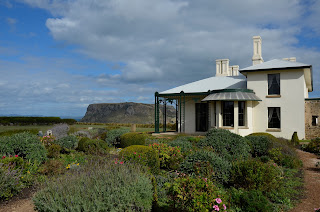
Stanley had been the headquarters of the London-based Van Diemen’s Land Company (VDL), which had been granted a charter to settle and cultivate Circular Head and the north-western tip of Tasmania in the 1800’s. The company built its headquarters at Highfield, on the high land north of Stanley. The house is now a historic site and has been restored to showcase the history of the area and the VDL. We visited Highfield that afternoon and were blown away by it. The museum is well thought out and the displays mean you can learn so much of the history without it being a boring visit. We spent ages exploring the house and it’s grounds, before making our way back to town to the old cemetery to follow more of the story of the VDL. Fascinating stuff.
 |
| Highfield |
 |
| Circular Head (The Nut) |
Hurseys Seafoods is an institution in Stanley and is renowned for its seafood. We dropped by that evening to pick up the best fish and chips we’ve ever had, before settling in for another night of being buffeted by the wind. We expected the north and west to be windy, but after two nights, we’d had enough and were looking for an escape plan.
The weather for the next week or so wasn’t going to be conducive to camping on the coast, which was a shame, because the north coast of Tassie is just beautiful. We had a plan now to scoot inland for a bit in the hope that it would be a bit less windy. We drove along the top of the coast and stopped in at Rocky Cape National Park. We parked up and did the short walk to the North Cave, but another pounding by the wind made us jump back in the car and keep driving. We also stopped in at Boat Harbour, where we had originally planned to camp. Yes, it was beautiful and if the weather had been good, it would have been a great camp, but there’s no use camping somewhere just to sit in your van to shelter from the wind.
 |
| Rocky Cape National Park |
 |
| Beautiful Boat Harbour Beach |
We drove along through Wynyard and looped around the large town of Burnie, before heading south towards Gunns Plains. Remember Judith, the old lady with the mutton bird stories? She had advised us that Gunns Plains was a beautiful area to visit, and she was right. We decided to stay at the Wings Wildlife Park, which was a bit of a sanctuary cum caravan park. We could choose to camp down by the river on the flat unpowered area, or to have power up on the hill. We had a bit of washing to do, and as power was only $20 per night, we chose that option. And now we were inland a bit, the wind had dropped completely, although the temperature was a bit cooler.
The town of Burnie was our destination the next day. Burnie is Tasmania’s fourth largest city. It is an industrial town, with a huge paper mill and port complex. During the 80’s and 90’s Burnie was labelled the dirtiest city in Australia, with the water in the port running red from the dyes of the paint factories. Burnie has undergone some fundamental changes in recent years and is now trying to re-invent itself as a tourist destination. While the port still remains an eyesore it is essential to the longevity of the city. The water colour is now back to crystal blue-green and the local council have brought life and vibrancy to the foreshore area.
We started our day at the Visitor Centre which also houses the Makers Workshop, a space where artisans make and display their creations. We watched wood turners and cheese makers. We took a paper-making tour and got a fabulous insight into making handmade paper, and got a hands-on experience producing our own. It was a great hour.
After leaving there, we walked the boardwalk along the foreshore into the centre of town and found a nice spot for lunch. The afternoon was spent at the Burnie Art Gallery, where they were hosting an exhibition of the 50 best cover photos from National Geographic magazine. It was amazing to see them and read a bit about their creators. Lastly, but in Doug’s mind, definitely not least, was a visit to the Hellyers Road distillery, where he sampled their fine drop. We had had a great day out in Burnie, and had a lovely drive back to camp via the little towns of Penguin and Ulverstone.
 |
| Whiskey tasting at Hellyer Road |
Our campground had approximately 15 or so permanent cabins, which were rustic weekend/holiday accommodation for their owners. When we got back to the van, there was a gathering of people on the deck of one of the nearby cabins, enjoying themselves muchly. One of the guys, who turned out to be the owner of the park, shouted over for us to join them, which we did. Well, we’ve never been made to feel so welcome anywhere. Everyone was super-friendly and the chat and banter flowed, as did the beer.
It turned out that most of them own a cabin in the park, and have done for many years (or their families before them). Every Friday night they gather on Ken’s verandah for a get-together. They're local farmers or tradies and were really wonderful people. We enjoyed a couple of hours in their company before most of them made a move to go and get their dinner. Ken invited us in to see his cabin, which was an extremely comfortable two bedroom affair, and we were “treated” to a song or two from him and his guitar - “do you like Roy Orbison???”. We were thankful that his voice was giving him jip that night and he could only manage two songs. He has been known to go on all night.
The rain had set in the next morning, and it was a wet hook up, but we were soon on our way again. We were quite sad to be leaving our friends at Gunns Plains, but will always smile when we think of them (especially Ken). The next stop we had planned was at the mural town of Sheffield. We drove back up and through Ulverstone and down into Sheffield. We checked out the free camp at the oval but couldn’t make up our mind. I guess we were getting a bit fussy about what we paid for. $5 per night for nothing but a gravel car park - hmmmmm. We thought we’d drive on to the next town of Railton, about 10km away to see what they had to offer. The RV camp was full (ish) and the free camp behind the pub was awful, so it was back to Sheffield for the night. The rain was still pelting down and we came up behind a big cycle race. Poor cyclists - it couldn’t have rained any harder. We were caught up in the convoy of support vehicles and other traffic and the going was slow, but we weren’t in a hurry and it was interesting to listen to the chat of the organisers over the radio.
The good thing was that the rain had cleared mostly, by the time we set up camp in Sheffield and we were able to spend a nice afternoon wandering around the town admiring the murals. Sheffield is a popular tourist destination because of its murals. For most of its history the town was a quiet farming backwater that struggled to exist. In the 1980’s the shopkeepers decided to take steps and copied the idea of painting murals from the Canadian town of Chemainus. Now with more than 140 murals, it really is an outdoor art gallery.
 |
| The World of Marbles in Sheffield |
The weather had turned for the worse again the next day, and as we left Sheffield and headed down the windy downhill road towards Mole Creek, the trailer brakes bit and the wheels slid on the wet roads. It was a bit of a hair-raising journey, but we reached the bottom, breathed a sigh of relief and made our way to the Mole Creek Hotel, where we enjoyed a hot coffee in the warm bar before setting up camp in the grounds of the pub.
We spent the afternoon visiting the nearby Trowunna Wildlife Sanctuary. We had given up hope of seeing a Tassie Devil in the wild, so we thought this might be the next best thing. Trowunna is a privately owned wildlife sanctuary, which started caring for native animals in 1979, and houses the world's largest heritage population of endangered Tasmanian Devils. The primary goal for Trowunna is conservation, education and rehabilitation. The facilities and infrastructure are a bit run down, but the staff are passionate about what they do. We were able to experience up close and personal interactions with wombats, devils and lots of other wildlife.
 |
| Feeding time |
We enjoyed a great meal in the pub that night and the best bit of all was our own wildlife interaction with the resident platypus in the creek that runs through the grounds the following morning. If you’re quiet while you cross the bridge you can see it playing in the shallow water without a care for you.
We had a few days to spare before our ferry back to the mainland, and we were conscious of the upcoming Easter weekend, so we thought we’d visit a few more areas south of Launceston before spending our last days at Old Mac’s. We travelled down the highway to Campbell Town, where we set up camp for the night in the park beside the river. The local council has instigated a permit system for self-contained RV’s to camp in their free camps. You organise your permit online, and they’ll email you your permit. You write the number on a bit of paper and stick it to the inside of the van window. Done! From Campbell Town we visited the nearby town of Ross, another historic convict town with wonderful old buildings and lots of history. It was easy to spend time wandering around enjoying the sunshine and soaking up the atmosphere.
 |
| The bridge at Ross |
Back at Old Mac’s it felt like we were coming home. We love Launceston and feel very at home there. Although it was busy for the Easter break, we were lucky to grab one of the lakeside sites and set up to enjoy our last few days. We started with devonshire tea in the Stonesthrow Cafe up the hill - so good - before heading into town for a spot of shopping and a visit to the Queen Victoria Museum. That’s a great place to spend an afternoon. Another day saw us journey out to visit the little town of Evandale, just south of Launceston and the convict sites near Longford.
Our last night in Tassie was planned for Girdlestone Park in Devonport. Nothing flash, but close to the ferry for our early departure the next day. We drove across from Launceston, stopping to stock up on cheese at the Ashgrove Cheese Factory and visit the lovely little town of Latrobe, before arriving in Devonport. We scoped out the local take aways and arranged for pizza to be delivered to the van that night - all sorted. Girdlestone Park was busy, with vans and motorhomes squeezing in every available spot (some on very uneven ground). It was apparent the boat was going to be busy the next day.
 |
| Ashgrove Cheese |
 |
| The Woodcutters Hall of Fame in Latrobe |
It was also forecast to the a bit of a rough crossing, so we hurriedly changed our booking from recliner chairs to a cabin. It’s not usually necessary to have a cabin for a day sailing, but it gave us a bit of space to spread out and somewhere to retreat to if we weren’t feeling crash hot. As it turned out, it wasn’t that bad. A bit rough, and I did feel a bit off, but Kwells to the rescue. We have decided that we wouldn’t choose a day sailing again. It is a long, boring day. We arrived not long after dark on Easter Sunday evening, and made our way through the traffic (what was this stuff???) and onto the freeway heading to our favourite resort in Pakenham.
So our two months in Tassie has come to an end. We thought that would be plenty of time. How wrong we were. There was still so much we didn’t see that there’s only one thing to do. We’ll have to go back again. It’s the most beautiful place - the scenery is beautiful, the people are amazingly friendly and it’s like living twenty or thirty years in the past (in the nicest possible way). It’s just wonderful. If you haven’t been, or even if you have, put a visit to Tassie on your bucket list.