Tuesday, 31 July 2018

A little town called Julia Creek - and how we got there.


After leaving Bourke behind, it wasn’t long before we crossed the border and entered Queensland, the fourth state on our tour of Oz.  We had 10 days to get to our next gig in Julia Creek - about 1600km away.  We were travelling up through the central west, through the town of Cunnamulla and onto and even smaller town called Eulo, on the Paroo River, where we spent the night.  Eulo is part of the Queensland opal fields, but we were there for a different reason.  We had heard about the famous Artesian Mud Baths in Eulo and had booked in for a late afternoon session.

The Cunnamulla Fella
An old couple, Nan and Ian, had been running the “bath house” on the outskirts of Eulo for years, and we were really impressed with our experience.  In their garden were several “rooms” made of corrugated iron, with no roofs, so we could see the sky, and each contained old clawfoot baths painted in bright colours.  Each room also had an open fire grate and a shower made in an old tree.


Our artesian bath house - before photos only
The order of activities went like this - 1. Artesian mud is mixed with lovely warm bath water and you soak in it for half an hour (while enjoying a glass of wine and nibbles).  2. You get out of the bath and take the container of artesian mud you’ve been left and rub it all over yourself.  3. You wait for the mud to dry (whilst standing beside the open fire as it’s starting to cool down as the sun goes down).  4. Once dry, you get back and soak in the bath for another 20 minutes or so.  5. You have a warm shower, towel off and smother yourself in their own moisturising balm.

We came out an hour and a half later and twenty years younger!

We moved on the huge distance of 80km the next day to another opal town - this time the peculiar little town of Yowah.  It’s only reason for existence is the opal fields and it’s famous for its boulder opals.  After a walk around town and a particularly nice coffee (we hadn’t had high expectations), we spent the rest of the afternoon in the artesian hot spring pools, soaking away any remaining aches and pains from the last rescue and enjoying the chat with fellow travellers.


The hot springs at Yowah - a great way to spend an afternoon
Yowah is situated in the middle of a large cattle property and the next morning, on our way away, we drove up to the top of the bluff to take in the views over the vast area.  


The Yowah opal fields


Looking out from the bluff at Yowah
We headed back up the road we’d come in the day before, and on to the small town of Quilpie.  Quilpie is a town on the Bulloo River, servicing the stations and other industries in the area.  Again, it’s in the opal belt, so we had to visit The Opal Hunter’s shop in town where we had a good chat with the “hunter” and learned a lot about how opals are formed and mined.  


Our camp on the Bulloo River at Quilpie


Opal encrusted alter in the church at Quilpie
From Quilpie we were heading for Windorah.  It was mid June, and in a few weeks thousands would be heading through this way to Birdsville for the Big Red Bash, but just now it was quiet - thankfully.  We lost a tyre on the road between Quilpie and Windorah - it wasn’t pluggable - so the rest of our driving that day and the next was with breaths held till we could arrange for a replacement in Birdsville.


The was no fixing this one

Crossing the Cooper Creek at Windorah
We were going to take two days to do the 470km from Windorah to Birdsville, but the Birdsville Development Road was in pretty good nick and we were making good time, so we did the trip in a day and rolled into a very green Birdsville late in the afternoon.  We got a great spot to camp on the common and were amazed at how the rains earlier in the year meant there was so much vegetation.  When we’d been here last year it was all dry and dusty.  Our original itinerary didn’t include a stop in Birdsville, but Matt had wanted a stockman’s shirt from the Birdsville Hotel for his birthday, so it meant a bit of a detour.  Not that far in the grand scheme of things.


Betoota - population 0 (the pub is about to open again)

The view from the Birdsville Development Road

Purchase obtained from the pub
We drove up the road from Birdsville, through Bedourie and on to Boulia, taking in all that the Diamantina Shire had to offer.  It really is one of the most beautiful parts of the country and an area we hadn’t visited before.  From Boulia we cut across farm land on a little used dirt road to McKinlay, famous for it’s Walkabout Creek Hotel (from Crocodile Dundee fame) and the final leg of our journey saw us cut across again from McKinlay to Julia Creek.  This was to be our home for the next 3 weeks and we were looking forward to our volunteer job here as caretakers of the free camp a kilometre out of town.


All settled in for our new role
Government surveyors arrived in this area in 1870 and officially listed the nearby watercourse as Julia Creek.  The township was founded in 1890 and really started its growth in 1908 when the railway was extended through.  The railway today is on the major rail link from Mt Isa to Townsville, moving ore from the nearby Cannington silver and lead mine, and cattle to market.  Huge trains lumber quietly through several times a day.  The town is also the administrative hub for the McKinlay Shire which consists of the towns of McKinlay, Nelia, Julia Creek and Kynuna.

Julia Creek has a population of about 600 people and a warm and welcoming feel.  The Shire Council is a very progressive one, and recognises the importance of the tourist dollar.  For about 6 years now they have been running the free camp to give people a reason to stop in Julia Creek rather than just driving through.  

The town is bright and neat and offers most services people could want and it’s encouraging to see new businesses opening rather than the usual scenario of businesses folding in a lot of country towns.  The towns folk are friendly and helpful and we were made to really feel part of the community straight away.  I would go up to town each morning to do a bit of shopping for dinner (great butcher shop in Julia Creek by the way) and would get waylaid chatting to people.  It was never just a quick visit.

During our time there we went to the Biggest Morning Tea at the primary school where we spent a great morning playing games and taking part if raffles etc (not to mention the absolutely fabulous food on offer courtesy of the all the parents).  We visited Reg, who has a fantastic veggie garden in his back yard and sells his produce for a few dollars and tells a great story or two while he’s got you.


Being entertained by the kids at the Biggest Morning Tea
One day we were invited to the quarterly Paddock to Plate lunch which showcased the locally farmed red claw and beef - not to mention the wonderful desserts made by the local ladies.  Food also features again with the CWA ladies having opened a new tea room and serving THE best scones, jam and cream every day.  The word was quickly spreading about the scones, as a lot of the travellers coming through our camp were asking directions to the tea room!!  Lynne, the CWA president made sure Doug was looked after and sent him take away scones to have at camp.

And you can’t (or shouldn’t) visit Julia Creek without taking in the Monday night bush dinner.  Each Monday night one of the local community groups takes a turn to put on a dinner at the local caravan park as a fundraiser.  The travellers staying at the park are invited, as are the travellers staying at the free camp (the Shire even sends a courtesy bus to pick us all up)!  Two courses for $15 and there was always entertainment and a raffle.  It was always a great night, and enjoyed by all who went - the record was set one Monday while we were there of serving 172 dinners!!  We were amazed at how many of the travellers who stopped at our camp had planned their stay around the bush dinners.


Bush Dinner - a real community event


Nice and warm on the cool nights
Our time at “The Creek” was spent welcoming visitors to the camp and explaining the guidelines around the need to be self-contained and generally making sure everyone enjoyed their stay and the place was peaceful.  It was a busy camp with between 40-50 vans a day coming in. Occasionally we’d have to politely move people on who didn’t fit the self-contained model and they usually didn’t put up a fuss.  I was less polite with the back packers who crept into camp late at night hoping to stay.  If I had to get out of bed and walk around camp following their tail lights in my PJ’s, then they were going to know I was annoyed.


Sunset on "The Creek"
All too soon our three weeks had come to an end.  Time flies when you’re having fun.  We met so many wonderful people during our time there - both towns people and travellers and had many happy hour conversations with tales of travel and campsites.


Happy hour entertainment
We hadn’t had any plans for after we left Julia Creek.  When people asked where we were headed next we’d shrug and say “roughly north”.  It was always a case of waiting to see what came our way, and as has usually happened so far, something has!  But that story can wait till next time.

Saturday, 14 July 2018

Farm Rescue - Mark III


Our time in the Louth area came to an end and we reluctantly said goodbye to all our new friends and started the journey to Bourke, where we’d planned a stop for a day or two so we could re-stock and clean up.

Things changed only 12km after leaving Louth when we heard a loud bang and lost a rear tyre to a big slash in the sidewall.  A road-side change was made a little more challenging than it should have been with the passing of 32 vehicles from the Landrover Club of ACT.  The wind was blowing their dust in our direction, so with each vehicle that passed, we crossed to the other side of the road to avoid being covered.  32 vehicles later…(and a lot of smiling and waving and “thanks for stopping, no we’re fine”) we finally got the wheel changed and were on our way again and we reached Bourke in a couple of hours.

No fixing this one.
The tyres on the car were reaching the end of their life but we’d hoped to make it to Mt Isa before needing to buy replacements, but with one slashed, one with a nail in a nasty place, one with a split in the sidewall that could go at any moment and our second spare the wrong size, we thought we’d better play it safe and bite the bullet and get six new tyres.  So on arrival in Bourke we went straight to the tyre centre and they were ordered and would be with us in two days.  Not bad eh?
We had a lovely camp at Mays Bend, about 15km north of Bourke on the Darling River and we spent our time visiting the exhibition centre, trying out the cafes and generally relaxing.  We were on our way again by Thursday with new boots on the car and heading to our next Farm Rescue near Brewarrina.  

The beautiful Mays Bend
Our farm this time was in an area about half way between Brewarrina and Walgett, then head north towards the Narren Lake National Park and the Grawin opal fields.  J and R have been farming the 22,000 acre sheep property for 3 generations and the drought conditions in the region have been making life hard.  They have de-stocked to 2,500 sheep and are hand feeding daily.
The NPWS had helped J move an old farmhouse from the national park to J’s property, as he was going to make it into shearers quarters.  But life and the drought got in the way and the old house was left in a bit of a state and wasn’t habitable. Every year, when the shearers came, J would have to pay travel time for them to come from Lightning Ridge and back every day and get an hours’ less shearing time into the bargain.  Our task for this rescue was to do as much as we could in the week to make the quarters habitable for the shearers, thus saving J a lot of money come shearing time.

The house was missing a front and a side when we arrived (not to mention the mess it was in inside)
Our team of 10 eager volunteers worked incredibly hard over the week we were there; cleaning, mending, patching, installing windows and doors, renovating the bathroom, painting, installing down pipes and a water tank - phew!!!!  You wouldn’t believe that the outcome - our sad old lady became a fresh, bright thing, with three bedrooms, a bathroom and a large room that would serve as a kitchen/dining room.  Large cracks in the walls and ceilings had gone, the missing ends of the house were restored and a bright front door finished her off beautifully.

Getting there - new windows and door - she's looking good

Getting to be a whizz with a roller
Nearly finished - just the final section of paintwork
Another great part of the Farm Rescues is the time spent and relationships built with fellow volunteers and the farmers.  We had worked with some of the volunteers before, and we met some more lovely people who are all there for the common goal.  

An afternoon off to enjoy lunch at the Glengarry Hilton
Our catering this time was done “in-house” with Rosey leading her crew of kitchen volunteers and we were working under some challenging conditions.  The camp stove supplied didn’t have the correct fitting to hook up to the gas cylinder, so the week was spent cooking on two little butane camp stoves and my Weber.  We were very inventive in what we cooked and how we cooked it but we managed to put a great meal for 11 people on the table every meal time.  Washing up was done in a plastic tub and the old shearers fridge in the shearing shed was working overtime.  After dinner and clean up, we all sat round a great camp fire until bed called.  It was never late as we’d worked so hard all day that we were pretty tired.
Challenges of catering
The exciting difference between this and other rescues we’d done was that a film crew from television show “The Living Room” was coming to do a story on the Farm Rescue program and cook us a meal.  

The crew of 7 arrived on a chartered plane and were picked up at Brewarrina air strip on Saturday morning.  The team included Grant Denyer and his wife Chezzie and celebrity chef Miguel Maestre.  They spent all Saturday and most of Sunday morning filming the various “scenes”.  God, working in television is a long, drawn-out affair.  Lots of hanging around, and doing it “one more time”.  But hopefully they got what they wanted and it turns out well.  I’m not sure they were ready for their rustic accommodation, but they handled it with great good humour.  Even the rickety old long-drop!!!

Room with a view - the long drop at sunrise
J, the farmer, had prepared an awesome bonfire for everyone on Saturday night, and we were entertained by stories and antics all evening.  Miguel and Grant became experts at toasting marshmallows on the fire, although we were worried about the burns they may have got being so close to the huge fire.  

Bonfire tree

Miguel toasting multiple marshmallows
Breakfast on Sunday morning was unexpectedly prepared by Miguel after we showed him the emu eggs we’d found a couple of days before.  He was amazed and so were we when he produced emu-egg frittata.  

Emu eggs - just on the ground, no nest

Miguel making an emu-egg frittata

Filming his cooking segment
Before we knew it, they were packing up again and being whisked off to catch their flight back to Sydney and we commenced the mammoth task of packing up all the tools and equipment and loading up the vehicles/trailers for departure the next day.

Celebrity friends
Our time spent with J and R was another great adventure for us, and hopefully they will get the benefit of our visit the next time shearing comes around.  After 10 days, we drove out the gate of their farm and headed towards Bourke for another re-stock.  Well, that was the plan, until we got the message from Rosey that we’d driven off and left our levelling ramps behind.  So, just 40km down the road, Doug unhooked the van and left me with it, and wheeled round and raced back to collect them.  
All good, and back on the road, we arrived in Bourke by early afternoon and decided to treat ourselves to a night in the caravan park.  I could do some washing, colour my hair and sit and watch TV with the heater on.  Sounded like bliss to me, and we enjoyed our night there, although it was packed and we were all squeezed in like sardines.  

The sky was blue but it was cold the next morning, as we headed out the gate and turned right.  Today was the start of the next chapter - Queensland.  Bring it on!!!!

Tuesday, 29 May 2018

Trilby - a month on a sheep station

This past month has seen us living and working at Trilby Station, near Louth in outback New South Wales.

We left Victoria mid-April and made our way slowly up through the country towns of the Riverina and the South-West Slopes, stopping along the way to enjoy what the towns had to offer and also one special stop in Narrandera, where I was able to catch up with a friend who I'd grown up with in Sydney.

Carcoar Dam - outside Blayney

We also called in for a few days to visit some relatives in Sydney, propping up on Uncle Neville's 5-acre property in Dural.  It was lovely to see them again, but we certainly did not miss the city and all its traffic and hustle-bustle.

On the road again on May 1, we travelled up through Bathurst and Orange, and stopped for a day to explore the historic town of Hill End.  It's a fascinating town that has been almost entire brought under the protection of Parks and Wildlife and stands as a great example of early settlement life in the gold rush era.
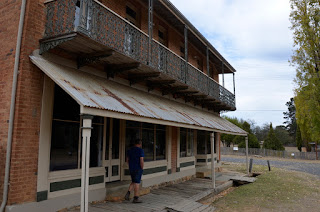
Hill End store

We moved on, heading slowly north-west, stopping at Mudgee and at Ponto Falls, and spent a great day in Nyngan, taking in the local show for a day.


Ponto Falls - outside Wellington

Cattle judging at Nyngan Show


From Nyngan we travelled through Cobar to Louth and stopped at the historic pub there (for research purposes only, I can assure you!!!)

After a weeks' slow dawdle up, we arrived at Trilby, ready for whatever was to come.  It was a bit exciting, but also a bit sad to see how dry the country is up here.

Trilby Station is an enormous sheep station, covering 320,000 acres with the Darling River forming part of its boundary.  Gary and Liz Murray own Trilby and have lived here, raising their 4 children since 1981.  Gary is part of the Murray family who have been farming this area  since the 1860's.  His kids are the 6th generation of Darling River farming Murrays.  Trilby was once part of the mighty Dunlop Station, a million acres in the 1880's.

Trilby from the air - note how far the floodplains extend

Dunlop Station homestead


The outback of NSW, and in particular the area around Trilby, hasn't had any significant rain since September 2016 and the area is officially in drought.  Due to the extreme drought, they have reduced their stock to 17,000 sheep and are hand feeding them all with barley, lupins, cotton seed and hay at a cost of $1 per sheep/week - $17,000 per week!!!

They've been hand feeding now for the past 6 months and they find it hard to remember what they did to fill in their days prior to the hand feeding routine of 2 days feeding, 1 day doing whatever else has buggered up in the meantime.  Hand feeding doesn't sound too bad, until you take into account the huge distances this property encompasses. We took a drive one day to the far end of the property to deliver some equipment, and we drove about 70km to get there, never leaving Murray land.

When the lads feed sheep, it involves moving the feed about over these distances, checking feeders haven't been emptied by feral goats or roos, checking water points and so on.  They leave before daylight and get back after dark.

Although the feral goats are a nuisance, they are also a very important income factor for the Murrays, and most sheep farmers around here, being the most widely exported meat out of Australia.  And there's plenty of them out this way!  A female goat begins breeding at about 7 months, has 2 kiddings a year and often bears 2, 3 or 4 kids at a time!  They graze on scrub rather than grasses, so are ideal for this scrubby country.  Being feral, they wander, going straight through fences, and are only considered yours to muster when they are on your property - if they go next door, they're no longer yours.

We have been really lucky to be working at Trilby during their busiest, and most exciting time of the year - shearing.  This began the week we arrived, and finishes this week.

Due to the size of the station, they have 5 shearing sheds, and the sheep in the vicinity of each shed are mustered and shorn there.  The shearing contractors moved into the quarters out at the far end of the property for a couple of weeks and travelled to the outer sheds, but have moved down to the shearers bunkhouse at the  main farm now for the final week.  The Murrays contract a shearing team, which consists of 6 shearers and about the same in roustabouts and wool classers.  They have a cook who travels with them and makes enormous amounts of food for them each day and tries to keep them all in line.
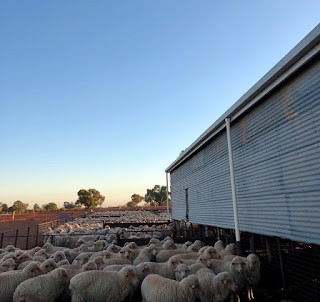
Waiting their turn at New Chum woolshed


Shearers at New Chum

Mick doing his thing


It's expected that, at the end of the shearing, they'll have around 450 bales of wool.  A bale weighs around 186kg, containing the wool from 32 grown sheep.  Wool prices are currently high, with 80% of Australian wool being exported to China, so that helps while the current drought makes it hard in other ways.

Trilby is a really well equipped station, with vehicles for every purpose.  There's the usual Toyota utes, bikes, quads, tractors, an excavator, a tipper truck, a prime mover, a low-loaders and my personal favourite, the 4WD buggy - I've had great fun running around on that.  Doug gets to play on tractors and with forklifts and we both enjoy a late afternoon drive around the river loop, checking on the campers - making sure they're settled and have everything they need.


Trilby also has two planes on the property - Gary has his workhorse Cessna and the oldest son, Tom, also has a plane for commuting when he needs to.  Gary uses his for mustering and checking stock - considering the huge distances that can be travelled it makes things a lot easier.

The planes also come into their own when the property is under flood.  During a flood the homestead and immediate surrounds become an island, isolated for months at a time, so with the planes, the Murrays are able to stay in their home and use the plane to fly to a higher airstrip on another part of the property where they can drive to "work" or to get supplies.  The last flood at Trilby was 2012.

To diversify a bit, Trilby offers accommodation to tourists - everything from lovely self-contained cottages (old Overseers and Jillaroos cottages), lovely secluded riverside campsites, some powered sites and the Shearers Bunkhouse.  The tourism side of the farm is busy and keeps Liz on her toes.  To help, she has teams of volunteers who come to help for a period of time over the busy months of the year.  That's where we come in.  In exchange for our powered site and lots of lovely lamb from the freezer, we were to offer 2 hours a day of helping out.

While we've been here, our main duties were, for me to keep the bathrooms clean and help with making up rooms etc and for Doug, to empty the bins around the campsites and make sure everyone had firewood etc.

What's happened, in fact, is that we both were enjoying our time here so much, and didn't want to sit about doing nothing, so we were doing much more than our key tasks; helping out in lots of other ways and enjoying being part of station life.  It's great to be able to help Liz out, as she is constantly on the go and hopefully we make things a bit easier for her.  And Doug has been kept busy doing lots of tree work - tidying up the trees around the cottages, homestead and campsite.  Because we had so much extra work to do, our time here has been extended from the original two weeks, to a month.  This meant we were able to spend some time with our friends Leanne and Paul.  They were the next volunteer couple and were supposed to back onto our time here.  As we've stayed on for an extra two weeks, we've now overlapped.
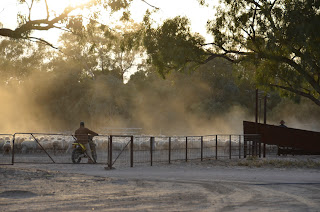
Morning muster

Shedding the sheep before shearing
Our time here will come to an end this weekend when we, sadly, have to say goodbye and move on.  We're only moving up the road initially, as the word has got around about the "Tree Guy" and he's now got a gig at the Louth pub, tidying up the trees in their campground and beer garden.

But for now, we're looking forward to the "cutting-out" party tonight, to celebrate the end of the shearing - it should be a big night!!!

Thursday, 3 May 2018

Farm Rescue - what can I say? Amazing!!!


After being back in Melbourne for 6 days, and getting lots of things done (catching up with family and friends, appointments, car maintenance etc etc etc), we were on our way again on the Saturday after Easter.

This time we were heading to something a bit different.  

Late in 2017, we had signed up for a weeks’ volunteer work with an organisation called Farm Rescue  - http://www.farmrescue.com.au/farm-rescue  

We were to be posted to a farm in the Ballendella area of northern Victoria, near Rochester and although we’d been given our job list, we were still a bit in the dark about what was involved.

Farm Rescue is a branch of the Rural Aid charity which organises trips each year to areas where farmers/rural families are in need of help.  For one reason or another, these people are struggling and a team from Farm Rescue is organised to spend some time with them and hopefully get something achieved that will help them.

Our first week was spent on a dairy farm in Ballendella owned by M&S with their two boys B(17) and C(7).  We arrived on Saturday afternoon and set up camp in the paddock near the house.  We were going to be right at home.  There was 6 volunteers in our team that week and Charles, the CEO of Rural Aid, who co-ordinated the whole event.

Camped in the horse paddock
Things officially got underway on Sunday evening, when we all met for dinner and an introduction at the pub in Rochester.  There was a lot of chat around the table and we were all looking forward to the week ahead. 
Our main task for the week was to convert a 4mx5m shed in the garden into a bedroom for B.  The family live in a tiny, 2 bedroom house on their farm, and now with B doing some serious study, he needed some space.  It was a complete transformation, with a floor needed over the dirt, insulation, window and door put in, electrical work, sheeting, painting and carpeting.  It was a big week.


As there was limited room for everyone to work at the same time in the shed, there were other jobs that we got stuck in with also.  Doug, being the tree man, made quick work of tidying up some trees around the property, Rosie (one of the other volunteers) and I tidied up the garden and did a huge burn off and Doug and Neal did some work around the cattle yards to improve the fences.

As volunteers, we all stayed on the farm, all meals were catered for and we all formed a really tight little band.  We were lucky to have Rosie, act as camp cook for the week and she (with the help of S) turned out some fabulous meals.  Time was spent round the fire after dinner each night and a lot of the worlds problems were put to right, believe me.

Team Ballendella
By spending time with these people and hearing their stories, a whole new understanding opens up.  The milk crisis that hit a couple of years ago was just something we’d heard about in the media and we made the token effort to try and not buy the cheap milk offered in the supermarkets to try and support the farmers.  But to hear exactly how it had affected this family and still affects them was astonishing.  Such a beautiful family getting their world pulled out from under them, with absolutely nothing they could do about it.  

They were so happy for us to be with them, and so generous of their time.  We learned so much.  M was happy for me to visit the dairy one morning to help with the milking and S and I went out on the quad bike to feed the calves.  The world of dairy farming was patiently explained to us novices, and we loved hearing how much there is involved.  Never underestimate what’s involved in your litre of milk.

The dangers of milking!!
Our week quickly came to an end.  Saturday morning saw B playing in the local footy league at a home game, and we all trooped along to support him (much to his embarrassment, I’m thinking!!).  It was a great feeling to have that local connection at something as grass-roots as a country footy match. 


Cheering on B
We had only signed up for one weeks’ rescue, but Charles told us there was another one the following week at nearby Girgarre.  Although it had been a hard week, we decided that we’d benefitted so much from the experience, we would go on to the second one.  It was sad to say goodbye to our host family, but we were happy knowing that B now had a bedroom that was useable and we had made a difference.  We felt like we had gained great new friends, and were sure we’d see them again.  Well, it’s a given really, since we were all given a voucher (expiry date infinity and beyond) to return and visit any time!

B couldn't wait - the bed was moved in that day.
The little band of volunteers packed up, hugged everyone goodbye and moved on to another dairy farm, this time owned by S&C with their four children, G(9), C(8), T(6) and J(2).  The group was getting bigger this week too, with the addition of 3 more volunteers and Grant, the new project manager hired by Rural Aid.  The charity hopes to increase the number of rescues done each year, and as such, Charles needed someone on the ground to manage things, and Grant was the man! 

Cosy camp around the derelict house

Camp from the air
The work was a bit different this week.  There was some work to be done at the main farm house (moving some plumbing in the bathroom and a new vanity and lots of fencing), but what kept most of us busy for the week was the derelict house across the road.  This was part of the farm and the owners had had some bad luck with bad tenants in the past; the house was trashed.  With a bit of help from Farm Rescue, it was hoped that the house would be made available for a farm labourer to live in.  S worked the dairy farm himself, and had a much bigger herd than the farm the previous week (about 300 cows).  If he was to have any family life at all, he needed someone to help him on the farm.

Our week was spent cleaning, scrubbing, sanding, painting, fixing and generally doing a “Block” reno, with tools down being called on Friday afternoon.  The house looked amazing - so much different from the shambles we saw when we arrived.  Doug and Lee (another volunteer) spent most of the week over at the main farmhouse, Lee transforming the bathroom and Doug fencing off a large area and making a playground for the kids.  Now C had somewhere to let J play without worry.  And when all that was done, Lee and Doug set about erecting a colour bond fence across the front of the farmhouse to keep all the kids safe from the road.  This job wasn’t finished by the end of the week, however, its given S a great start.


Rosie and Allie in sync

Who's the nonna?


The playground taking shape
S and C and their children joined us for dinner each night at camp, which was lovely and Allie (volunteer) had the kids organised into a super-dooper washing up team.  It was lovely the share time with them and hear about what they’d been doing at school.  We had our celebration final evening on Friday and were so touched by the lovely cards and messages the kids had made for us.

Dinner for 22 each night!!
By the time the end of the fortnight came, there was 6 very, very tired people.  But there was also 6 people who had gained so much from our time together on the rescues.  We have made some great new friends, we have learned so much, we have gained an insight into the struggles of others and we have tried to help.  Would we do it again?  In a heart-beat.  In fact, we’ll be signing up for more as soon as we can.